
img
BRUE for the Final FRCEM SBA Exam
By FrcemStudyZone editorial Team
20 Feb, 2026

BRUE for the Final FRCEM SBA Exam

BRUE for the Final FRCEM SBA Exam

The Definitive Consultant-Level Guide to Risk Stratification, Investigations & Disposition

image.png 305.92 KB
Brief Resolved Unexplained Event (BRUE) is a high-yield paediatric topic in the Final FRCEM SBA exam. It tests structured clinical reasoning, safeguarding vigilance, precise risk stratification, and proportionate management. This SEO-optimised cornerstone guide is tailored for FRCEM candidates across the UK, Ireland, and the Middle East, and aligns with RCEM practice standards.

For curriculum alignment and exam blueprint context, see Royal College of Emergency Medicine and explore learning resources via RCEMLearning.

What Is a BRUE? (Exam Definition)

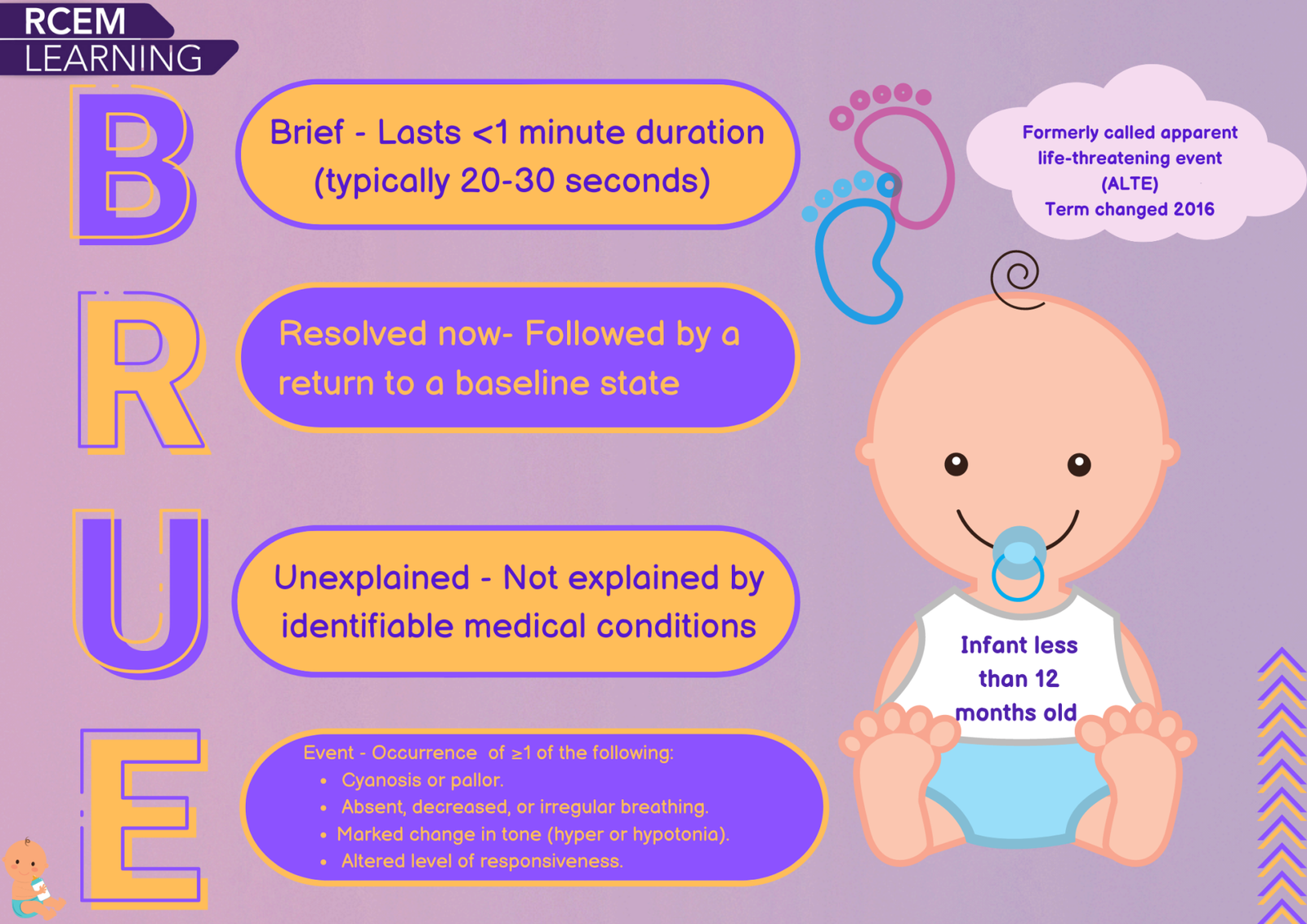
this picture Illustration is from "rcem eLearning "

BRUE_1.png 1.65 MB

A BRUE is an event in an infant <12 months that:

  • Lasts <1 minute (typically 20–30 seconds)
  • Has a clear beginning and end
  • Has completely resolved before ED assessment
  • Remains unexplained after appropriate history and examination
  • Includes ≥1 of:
    • Central cyanosis or pallor
    • Absent, decreased, or irregular breathing
    • Marked change in tone (hyper/hypotonia)
    • Altered responsiveness

Key Principle: BRUE is a diagnosis of exclusion—not a disease entity.

Why BRUE Is Frequently Tested in Final FRCEM

BRUE SBAs assess:

  • Accurate application of definitions
  • Differential breadth (seizure vs reflux vs arrhythmia)
  • Corrected age calculation
  • Risk-based investigation
  • Safeguarding integration
  • Safe discharge planning

High scorers apply criteria strictly and avoid premature closure.

Differential Diagnosis: Exclude Before You Label

Systematically consider:

Cardiac

  • Congenital heart disease
  • Arrhythmias
  • Prolonged QT (ECG essential if suspected)

Respiratory

  • RSV/bronchiolitis
  • Pertussis
  • Airway obstruction (FB, laryngomalacia)

Gastrointestinal

  • Reflux with laryngospasm (feeding-associated, obstructive apnoea)

Neurological

  • Seizure (eye deviation, rhythmic jerking, post-ictal phase)
  • Head injury

Metabolic/Toxins

  • Hypoglycaemia
  • Electrolyte disturbance
  • Drug ingestion

Safeguarding

  • Non-accidental injury (NAI)
  • Fabricated/induced illness

If a cause is identified, it is not BRUE.
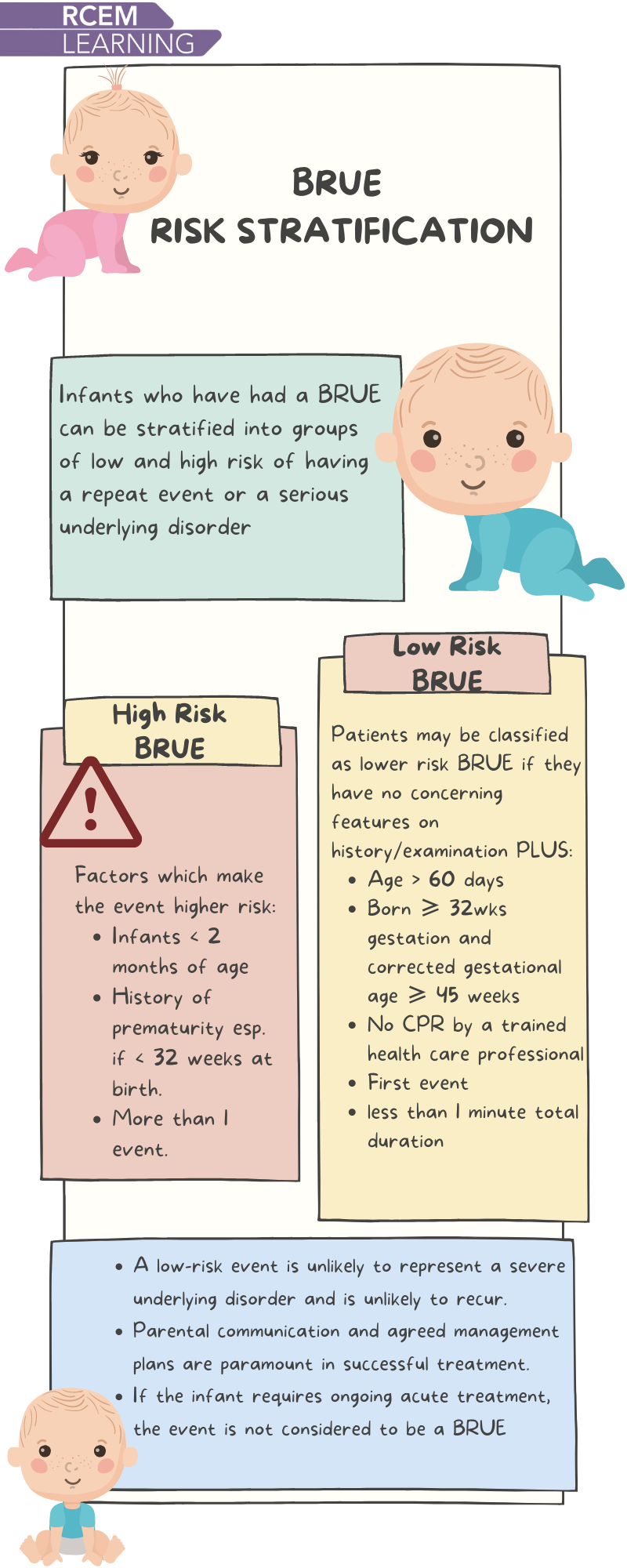
Risk Stratification (The Exam Pivot)

BRUE_Risk_stratification.png 350.2 KB
LOW-RISK — All Criteria Required

  • Age >60 days
  • Born ≥32 weeks’ gestation
  • Corrected age ≥45 weeks
  • First event
  • Duration <1 minute
  • No CPR by healthcare professional
  • No concerning history or exam findings

Low-risk BRUE:

  • Severe pathology unlikely
  • Not associated with SIDS
  • Minimal investigation required

HIGH-RISK — If Any Criterion Fails

  • Age <60 days
  • Born <32 weeks
  • Corrected age <45 weeks
  • Recurrent episode
  • Event >1 minute
  • CPR by healthcare professional
  • Abnormal exam or safeguarding concerns

High-risk → admit for monitoring ± targeted tests.

Corrected Age Calculation (Common SBA Trap)

Corrected age = Chronological age − Weeks premature
Weeks premature = 40 − Gestational age at birth

Example:
24 weeks old, born at 28 weeks
Weeks premature = 12
Corrected age = 24 − 12 = 12 weeks → High-risk

Precision here distinguishes consultant-level candidates.

Investigations: Proportionate & Risk-Based


LOW-RISK

  • No routine investigations
  • Short ED observation (1–4 hours)
  • Consider capillary glucose ± ECG only if indicated

Avoid blanket septic screens and prolonged admission.

HIGH-RISK (Minimum)

  • Capillary blood gas (glucose, bicarbonate, lactate)
  • ECG (assess QT interval)
  • Continuous cardiorespiratory monitoring
  • Further tests guided by suspicion (± NPA for pertussis/RSV)

Exam tip: ECG is to evaluate QT; capillary gas screens metabolic causes.

Disposition & Monitoring

LOW-RISK

  • Observe 1–4 hours in ED
  • Observe a feed
  • Senior review
  • Shared decision-making
  • Discharge with written advice

HIGH-RISK

  • Paediatric referral
  • ~24-hour monitoring
  • ± Investigations

Discharge Advice (Document Clearly)

Safe Sleep

  • Supine position
  • Firm, flat mattress
  • Avoid loose bedding
     Resources: The Lullaby Trust

Smoke-Free Environment

  • No tobacco exposure at home or in cars

Infant BLS (Offer Sensitively)

  • Signpost to Resuscitation Council UK
  • Frame as empowerment, not alarm

Never Shake the Infant

  • Explicit advice; document

GP Review

  • Within 48 hours
  • Clear return precautions

Communication & Safeguarding

  • Involve parents in evaluation and discharge planning
  • Assess psychosocial context
  • Document important negatives and normal variants
  • Integrate safeguarding into decision-making

SBA nuance: Suggesting CPR training may increase anxiety—use shared decision-making.

Top Final FRCEM SBA Pitfalls

  • Forgetting corrected age
  • Misapplying ≥32-week threshold
  • Confusing parental stimulation with professional CPR
  • Over-investigating low-risk infants
  • Missing seizure features
  • Ignoring safeguarding cues

Quick-Reference Table

CriterionLow-RiskHigh-RiskAge | >60 days | <60 days
Gestation | ≥32 weeks | <32 weeks
Corrected Age | ≥45 weeks | <45 weeks
CPR (professional) | No | Yes
Duration | <1 min | >1 min
Recurrence | First event | Recurrent

Fail one criterion → high-risk pathway.

Alignment With RCEM Standards

This guidance reflects paediatric emergency reasoning consistent with the Royal College of Emergency Medicine curriculum and learning objectives available via RCEMLearning.

Candidates should regularly review paediatric emergency modules on RCEMLearning to reinforce exam-aligned reasoning.

Final Takeaway for Global FRCEM Candidates

Whether preparing in the UK, Ireland, or the Middle East:

  • BRUE is a diagnosis of exclusion
  • Risk stratification drives management
  • Corrected age must be calculated precisely
  • Low-risk → minimal intervention
  • High-risk → admit and monitor

Disciplined reasoning—not defensive medicine—wins marks in the Final FRCEM SBA.

check our website for high quality frcem final sba questuibs regarding this topic here please :  https://www.frcemstudyzone.co.uk/demo-quiz?category_id=7

Tags:
Final FRCEM SBA Exam Practice | FRCEM Study Zone Prepare for the Final FRCEM SBA Exam with authentic consultant-level questions, RCEM-guideline based answers, and full mock exams Final FRCEM SBA, FRCEM Study Zone, RCEM SBA questions, RCEM exam preparation, FRCEM mock exams, MRCEM SBA, Emergency Medicine exam, FRCEM online course, FRCEM question bank, FRCEM consultant exam, FRCEM study materials, RCEM guidelines, FRCEM final paper, Final FRCEM Single Best Answer questions FRCEM SBA mock exam packs Consultant-level RCEM curriculum questions Emergency Medicine online exam preparation FRCEM revision questions and explanations RCEM 2021 curriculum-aligned content FRCEM SBA exam ti How to pass the Final FRCEM SBA Exam Latest RCEM guidelines explained Common pitfalls in Final FRCEM SBAs RCEM curriculum updates 2021–2025 Evidence-based FRCEM learning resources
Search Articles
Related Articles
FRCEM Study Zone: Your Complete Resource for Final FRCEM SBA Success”
By FrcemStudyZone editorial Team • 25 Sep, 2025
Mastering the Final FRCEM SBA: Strategies, Techniques & Consultant Advice
By FrcemStudyZone editorial Team • 08 Oct, 2025
Popular Tags