
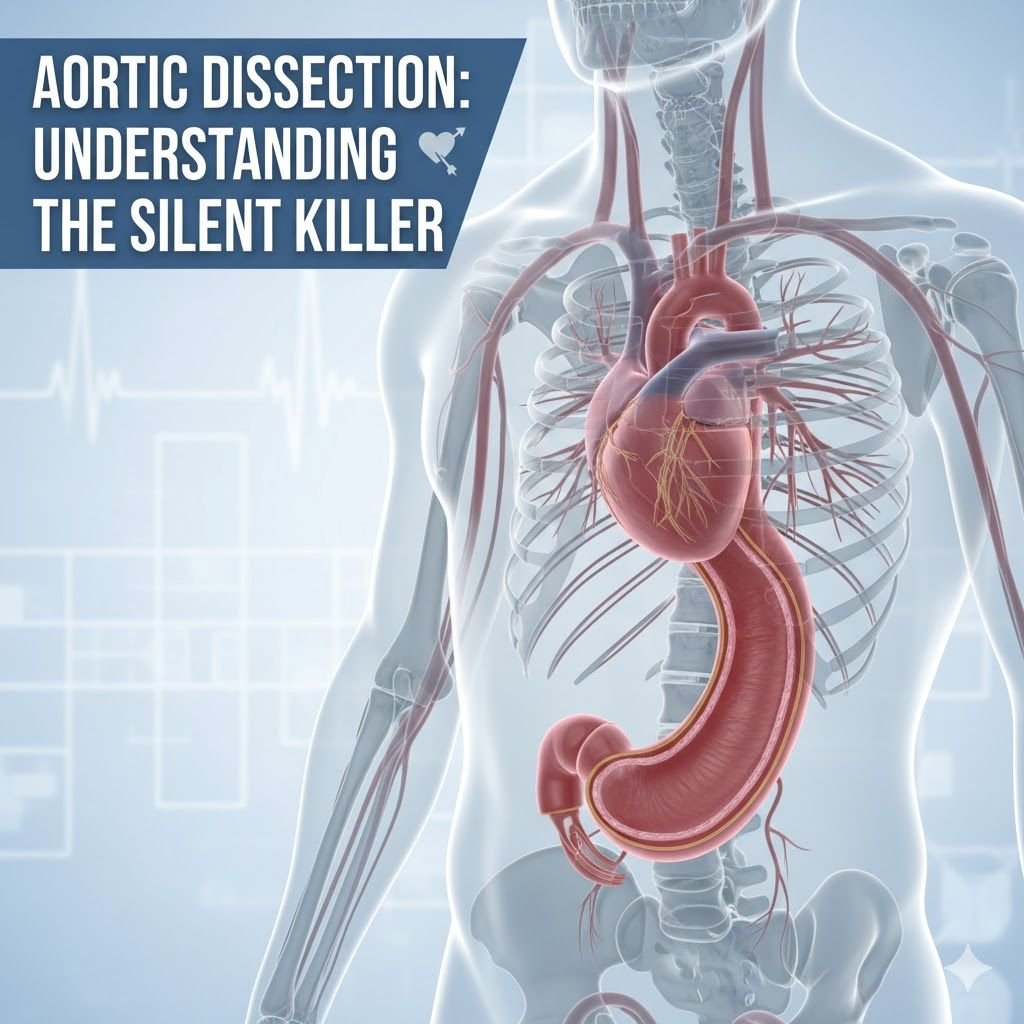
03/11/2025.
🩺 Thoracic Aortic Dissection (TAD) — High-Yield Clinical Guide for Final FRCEM SBA Preparation
© FRCEM Study Zone 2025 | Where Preparation Meets Precision
Author: Dr Murtada Naser | Emergency Medicine Consultant (NHS)
Curriculum: RCEM 2021 Final FRCEM Blueprint
Primary Sources: RCEM / RCR Best Practice Guideline (2025) and ESC Aortic Diseases Guideline (2014)
⚡ Epidemiology & Core Risk Profile
Incidence: ≈ 4–7 cases / 100 000 population / year.
In-hospital mortality: ≈ 27 %.
Diagnostic challenge: Often misdiagnosed as Acute Coronary Syndrome (ACS), which is 100–200 times more common.
🔹 Major Risk Factors
Hypertension (> 70 % of cases)
Genetic connective-tissue disease — Marfan / Ehlers–Danlos syndromes
Vasculitides — Giant Cell Arteritis, Takayasu Arteritis
Congenital aortic abnormalities — bicuspid aortic valve, coarctation
Recent aortic instrumentation or cardiac surgery
Pregnancy (3rd trimester)
Male sex and advancing age (> 60 years)
💡 Exam Tip: Any hypertensive male > 60 years with abrupt back pain is a potential dissection until proven otherwise.
Explore this further in our Demo Question Series on High-Risk Cardiovascular Emergencies
.
🧠 Clinical Presentation — Recognising the Aortic Disaster
DomainKey FeatureExplanation / Learning PearlPain | Abrupt onset, maximal at start, “tearing / ripping / stabbing”, radiating to back or jaw | Central to differentiation from ACS — dissection pain peaks immediately.
Haemodynamics | Marked BP asymmetry > 20 mmHg or pulse deficit | Indicates branch vessel involvement.
Cardiac | New early diastolic murmur → Aortic Regurgitation | Secondary to aortic root involvement.
Neurological | Syncope, stroke-like features, spinal or limb ischaemia | Due to carotid / spinal artery compromise.
Systemic | Shock, collapse, renal failure, tamponade | Often final pathway if diagnosis delayed.
🧩 Clinical Rule: TAD may present as chest pain, collapse, stroke, or abdominal pain — beware the painless dissection.
📊 Investigations — From Screening to Definitive Imaging
🔹 First-line Tests
CXR: widened mediastinum / pleural cap / tracheal deviation (but 15 % normal).
ECG: non-specific ST-T changes / normal in ≈ 30 %.
D-dimer:
> 500 ng/mL FEU + ADD-RS ≥ 1 → CT Aortogram
ADD-RS ≥ 2 → CT Aortogram directly
🔹 Imaging Hierarchy
Modality Sensitivity / Limitation Guideline Comment
CT Aortogram (ECG-gated) | ≈ 100 % | Gold standard; arterial-phase with non-contrast and contrast series.
TTE | May miss ≈ 30 % | Use only in unstable / peri-arrest while preparing for CT.
TOE | Sensitivity ≈ 99 % | Best for Type A intra-op or ICU diagnosis.
🩻 Internal Learning Link: See our Imaging Masterclass Demo Questions
for CT vs TOE comparisons and pitfalls.
🧮 ADD-RS (Aortic Dissection Detection Risk Score)
Domain Criteria Score
High-risk condition | Marfan / Ehlers–Danlos / bicuspid valve / aneurysm / recent manipulation | +1
Pain features | Abrupt / severe / tearing pain | +1
Clinical findings | Pulse or BP deficit, neuro deficit + pain, AR murmur + pain, shock / hypotension | +1
≥ 2 → Immediate CT Aortogram
1 + D-dimer > 500 → CT Aortogram
0 + D-dimer ≤ 500 → Alternative diagnosis
🧠 Mnemonic: Condition → Pain → Findings = “CPF”.
🏥 Emergency Department Actions & System Governance
ED Ownership: The clinician who suspects TAD must request and act on the CT result — it cannot be delegated to another team.
Imaging Access: 24-hour ECG-gated CT Aortogram availability is mandatory.
Transfer Pathway: Immediate liaison with regional aortic centre if Type A dissection confirmed.
BP and HR Targets:
Systolic BP: 100–120 mmHg
HR: ≈ 60 bpm via IV labetalol or esmolol
Pain Control: Morphine + β-block titration to prevent sympathetic surge.
Do not delay CT for D-dimer if clinical features are high risk (ADD-RS ≥ 2).
📚 Review our Governance and Imaging Responsibility Demo SBA
to see how this applies in real-time consultant decision-making.
💎 Six Consultant-Level Single Best Answer Scenarios
Q1 – Subtle Presentation Missed in Triage
A 56-year-old hypertensive smoker with sudden inter-scapular pain radiating to jaw.
CXR normal; ECG non-specific; BP 150/80 (L) vs 122/70 (R).
Next step: ➡️ CT Aortogram (unequal BP + abrupt pain = high ADD-RS).
Full discussion in our Demo SBA Case 1 — Chest Pain with Unequal BP
.
Q2 – Neurological Mimic of Dissection
A 68-year-old with collapse and left-leg weakness; CT Head normal; BP difference 30 mmHg.
Investigation: ➡️ CT Aortogram — suspect spinal or limb ischaemia from dissection.
Q3 – Diagnostic Pathway Application
45-year-old woman with Marfan’s and abrupt tearing pain → ADD-RS = 2.
Immediate CTA required — no need to wait for D-dimer.
Q4 – False-Positive D-dimer
59-year-old male, 24-h mild pain, DDimer 950 ng/mL, ADD-RS = 0.
Answer: Seek alternative diagnosis — false positive rate high.
Q5 – Imaging Access & Responsibility
70-year-old with tearing pain and shock at 03:00; radiology asks for “medical review first.”
Action: ➡️ ED consultant requests and owns CT Aortogram result.
Q6 – D-dimer Rule-in Threshold
50-year-old hypertensive man with abrupt pain; ADD-RS = 1; D-dimer 820 ng/mL.
Next step: ➡️ ECG-gated CT Aortogram (> 500 FEU + risk score 1).
🧩 Key Statistics for Exam Recall
ParameterData PointNormal CXR in TAD | 15 %
Normal ECG in TAD | 30 %
TTE false-negative rate | ≈ 30 %
Mortality increase per hour of delay | 1 % per hour (untreated Type A)
In-hospital mortality | 27 %
🔗 Further Learning & Internal Navigation
🩻 Imaging Algorithm Demo Questions
— CT Aortogram vs CTPA vs TTE selection.
🧠 Neurological Mimics of Dissection Pack
— stroke vs TAD differentiation.
💉 Haemodynamic Targets SBA Series
— BP 100–120 mmHg and HR ≈ 60 bpm management.
📚 Governance & Imaging Responsibility Cases
— ED ownership of critical imaging.
📘 References
RCEM / RCR Best Practice Guideline (2025) – Diagnosis of Thoracic Aortic Dissection in the Emergency Department
RCEM Learning (2024) – Acute Aortic Syndrome eLearning Module
ESC (2014) – Guidelines on Aortic Diseases
FRCEM Study Zone (2025) – Final SBA Packs & Demo Cases Collection